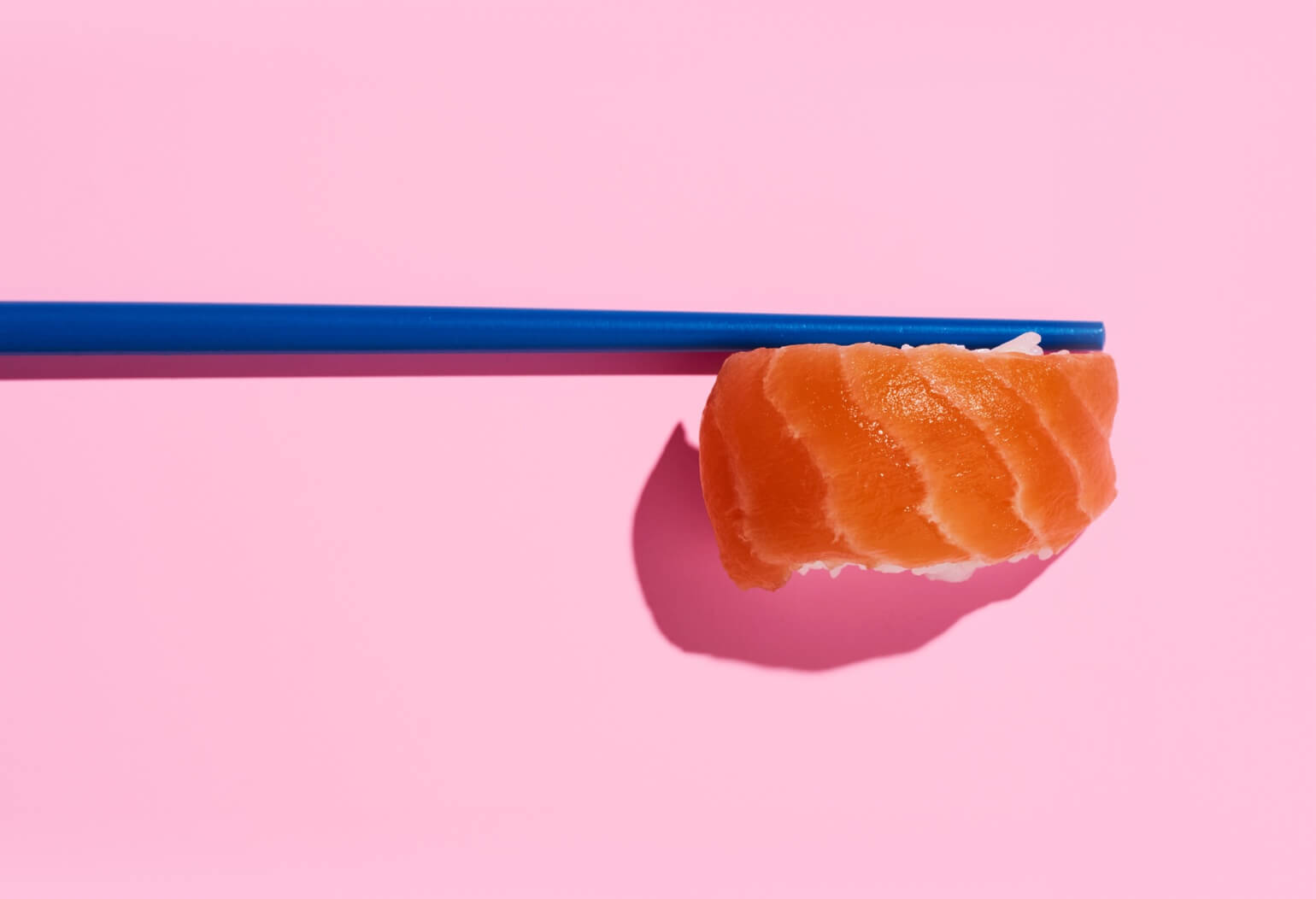
Bluehouse Salmon: 8 Common Myths, Busted
When it comes to salmon and sustainable seafood, there are still a lot of common misconceptions. Some people question how fish can be raised on land. Others assume responsibly raised salmon is packed with antibiotics, less nutritious, or harmful to the environment. Bluehouse Salmon was built to challenge those assumptions. Here is the truth behind eight of the most common salmon myths.
Myth 1: Farmed salmon is full of antibiotics, hormones, and artificial dyes.
Bluehouse Salmon is raised completely antibiotic free and hormone free. Our land-based Bluehouse gives us full control over the environment our fish live in from the moment they hatch. Raised in closed-water containment, our salmon are never exposed to the ocean, eliminating many of the challenges faced by conventional ocean farming and removing the need for antibiotics.
These clean, carefully controlled conditions allow us to raise healthy fish without unnecessary additives. Bluehouse Salmon is also non-GMO, and our controlled water environment protects our fish from exposure to ocean pollutants such as microplastics and mercury. The vibrant color of Bluehouse Salmon comes from astaxanthin, the same antioxidant that gives wild salmon its natural pink color, and is provided through our carefully balanced feed, not through artificial dyes added to the fish.
In addition, Bluehouse Salmon carries the American Heart Association’s Heart-Check certification, giving consumers confidence in both the quality and nutritional benefits of our salmon.
Myth 2: Farmed salmon is bad and wild caught is always healthier.
Wild salmon can absolutely be a great choice, but the idea that wild is always healthier overlooks a bigger picture. The health and quality of salmon are not determined by whether it is wild caught or responsibly raised. What matters most is the environment it comes from, the care it receives, and the standards behind how it is produced.
Bluehouse Salmon is raised on land in a carefully controlled environment designed to support healthy fish from egg to harvest. This allows us to manage every part of the process, from water quality to nutrition, while providing consumers with a fresh, traceable source of healthy protein.
As global demand for salmon continues to grow, wild-caught salmon alone cannot meet the world’s increasing need for seafood. Responsibly raised salmon helps provide a reliable source of nutritious protein while reducing pressure on wild salmon populations.
Myth 3: Fish should always come from open ocean waters.
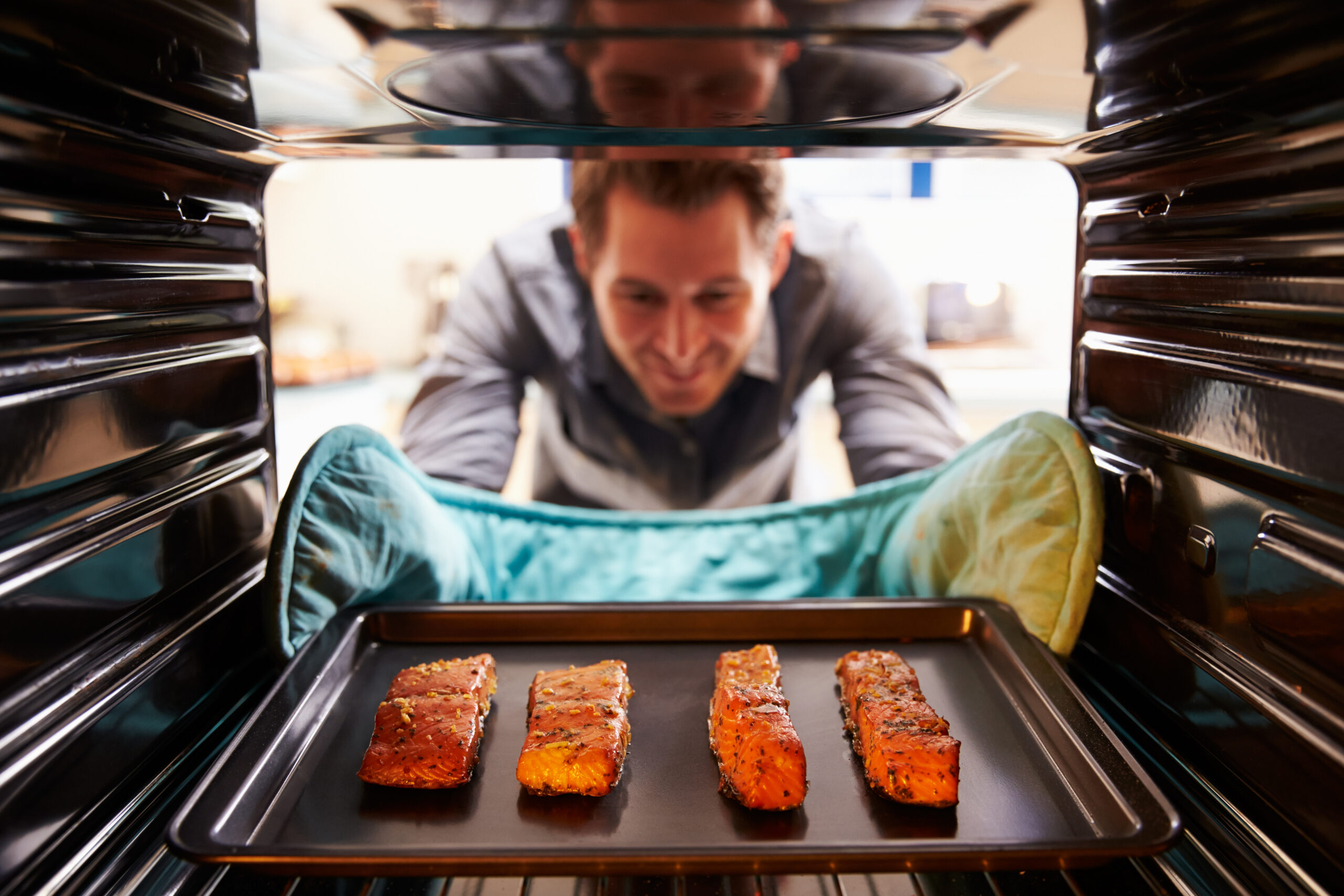
Man Taking Cooked Tray Of Salmon Fillets Out Of The Oven
A Health Perspective
Many people assume salmon raised in the ocean is the most natural choice, but open ocean environments expose fish to conditions that producers cannot fully control. Ocean raised salmon (both wild and farmed) may encounter parasites, changing water conditions, and environmental contaminants that exist in the surrounding marine environment.
Bluehouse Salmon is raised on land in a carefully controlled environment using water sourced from a naturally filtered Floridan aquifer. Because the fish are raised outside the ocean, they are protected from sea lice and many of the biological challenges associated with conventional ocean farming. The result is consistent, traceable salmon raised in a clean and controlled environment.
An Environmental Perspective
Ocean farmed salmon can create challenges for surrounding marine ecosystems. Fish waste and excess nutrients are released directly into coastal waters, escaped fish can interact with wild populations, and imported salmon often travels thousands of miles before reaching consumers.
Bluehouse Salmon is raised entirely on land in a closed water system that recycles more than 99 percent of its water. There is no risk of fish escapes and no discharge of fish waste into the ocean. Water from our facility is carefully treated and managed using the same underground wastewater system used throughout South Florida. Within our processing operations, we strive to utilize every part of the fish, supporting our goal of zero waste of off cuts and byproducts. The result is a more local, responsible approach to producing salmon while helping protect wild fish populations and marine ecosystems.
Myth 4: Salmon should eat the same diet they would in the wild.
A Health Perspective
Wild salmon get their Omega 3s and pink color from the marine food chain, leading some people to believe that farmed salmon must eat exactly the same diet to provide the same nutritional benefits.
In reality, salmon require specific nutrients, not specific prey. Bluehouse Salmon is fed a carefully formulated diet designed to provide the protein, vitamins, minerals, Omega 3 fatty acids, and antioxidant carotenoids salmon need to thrive. The result is nutritious salmon that is rich in Omega 3s and high quality protein.
An Environmental Perspective
If every salmon consumed today relied entirely on wild fish for feed, the pressure on marine ecosystems would continue to grow. Modern aquaculture feeds are designed to use marine ingredients more efficiently while reducing dependence on small wild fish that have traditionally been used in salmon feed.
Bluehouse Salmon works closely with its feed partners to incorporate responsibly sourced ingredients and continually improve feed sustainability. Some marine ingredients come from trimmings and byproducts that would otherwise go to waste, helping maximize the use of existing resources. We continue to explore innovative ingredients and new technologies that reduce pressure on wild fish populations while maintaining the health and nutrition that consumers expect from salmon.
Myth 5: The best salmon has to come from overseas.
For decades, consumers have been told that the best salmon comes from places like Norway or Chile. But the reality is that distance does not make seafood better. Freshness does.
Today, 96% of the Atlantic salmon consumed in the United States is imported, often traveling thousands of miles before it reaches grocery stores and restaurants. Much of this salmon depends on complex international supply chains and long transportation routes before arriving on American plates.
Bluehouse Salmon is raised from egg to harvest in Homestead, Florida, processed on site, and delivered directly to customers across the country. By raising salmon close to the people who eat it, we can provide a fresher product with a shorter supply chain and less dependence on overseas imports. While imported salmon can take 7–9 days or more to reach U.S. grocery stores, Bluehouse Salmon can arrive in just 2–4 days after harvest.
Producing salmon in the United States also reduces the need for international air freight, one of the largest contributors to the carbon footprint of imported salmon. More than 99 percent of our water is recycled within the Bluehouse, and over 95 percent of our water use comes from saltwater that is not suitable for drinking or irrigation. In 2025, 39% of our electricity consumption came from solar energy, and we are committed to continuing to expand our use of renewable energy.
The best salmon is not determined by how far it travels. It is determined by how responsibly it is raised, how fresh it is when it reaches your plate, and how well it supports the communities it serves.
Myth 6: Farmed salmon is not as nutritious as wild caught.
Salmon has earned its reputation as one of the healthiest proteins you can eat, and responsibly raised salmon delivers the same nutritional benefits consumers seek from wild fish.
A 4 ounce serving of Bluehouse Salmon provides 23 grams of high quality protein and more than 2,000 milligrams of Omega 3 fatty acids. It is also an excellent source of vitamin D, an important nutrient that many Americans do not get enough of. These nutrients support heart, brain, muscle, and immune health.
Bluehouse Salmon gets its natural pink color from antioxidant carotenoids in its diet, just as wild salmon do. And because nutrition is about what a food provides, not simply where it comes from, consumers can feel confident that responsibly raised salmon remains one of the most nutritious foods they can put on their plate.
In fact, the American Heart Association recommends eating fatty fish at least twice a week as part of a heart healthy diet, and Bluehouse Salmon meets the organization’s Heart Check certification standards.
Myth 7: Farmed salmon is bad for the environment.
Many concerns about farmed salmon come from the challenges associated with traditional ocean farming. But not all aquaculture is the same, and how salmon is raised matters.
As demand for seafood continues to grow, wild-caught salmon alone cannot meet the world’s need for healthy protein. The United States imports the vast majority of its seafood, including 96 percent of the Atlantic salmon Americans consume. Producing seafood closer to the people who eat it can help strengthen food security, reduce transportation impacts, and provide a more resilient food system.
Bluehouse Salmon was designed to rethink how salmon can be raised. By producing salmon on land in the United States, we can provide fresh seafood closer to consumers while helping reduce pressure on wild fish populations. Our approach combines responsible resource use, local production, and innovative technology to help meet growing demand for seafood.
The future of sustainable seafood is not about choosing between wild and farmed. It is about finding better ways to raise healthy fish while protecting the oceans for future generations.
Myth 8: Sustainability claims are just marketing.
Consumers are surrounded by labels, certifications, and environmental claims, making it difficult to know which products truly deliver on their promises. Independent verification matters.
Bluehouse Salmon is certified by the Aquaculture Stewardship Council, one of the world’s leading standards for responsible aquaculture, and carries a Seafood Watch Best Choice recommendation. Our products also meet the standards of the American Heart Association’s Heart Check program.
Traceability is built into our entire operation. Every fish can be tracked throughout its journey from egg to harvest, processing, and distribution. Our integrated Bluehouse allows us to maintain oversight of the entire production process while delivering salmon directly to customers.
Food safety and quality are held to the same high standards. Bluehouse Salmon is SQF certified, meeting globally recognized requirements for food safety and quality management throughout our operations.
Sustainability should not depend on marketing claims alone. It should be supported by transparency, independent certifications, responsible practices, and measurable standards that consumers can trust.
What You Are Actually Getting
Bluehouse Salmon is raised without antibiotics, hormones, or pesticides. It is non GMO, tested clean for PCBs, mercury, and microplastics, and carries some of the highest sustainability and health certifications in the industry:
- Best Choice by the Monterey Bay Aquarium Seafood Watch program
- Heart Check Certified by the American Heart Association
- Raised in a pure aquifer water source free from mercury or microplastics
- Packaged without styrofoam or single use plastics
- ASC (Aquaculture Stewardship Council) Certified
It is also, simply, very good salmon. Because it does not spend days traveling across oceans and through complex international supply chains, it reaches stores with a level of freshness that imported fish rarely achieves.
We believe the future of seafood is local. Raising salmon in the United States means fresher fish, greater transparency, shorter supply chains, and less dependence on imported seafood. It means knowing where your food comes from and how it was raised.
That is what Bluehouse Salmon delivers.
Your Questions, Answered

To learn more about how the Bluehouse works, visit bluehousesalmon.com/thebluehouse or browse the full FAQ at bluehousesalmon.com/faq.
The Bottom Line
Perhaps the biggest myth of all is that seafood has to be produced the way it always has been. For generations, consumers have been told that the best salmon must come from distant oceans, travel thousands of miles, and be raised using traditional methods. But as demand for seafood grows and technology advances, new approaches can deliver fresh, nutritious salmon while addressing many of the challenges facing our food system.
Bluehouse Salmon was created to prove that there is another way. One that brings seafood production closer to home, gives consumers greater transparency, and challenges long held assumptions about what salmon can be.
Where can I find Bluehouse Salmon? Visit bluehousesalmon.com/where-to-buy to find a retailer near you.